


Marie-Julie Jahenny
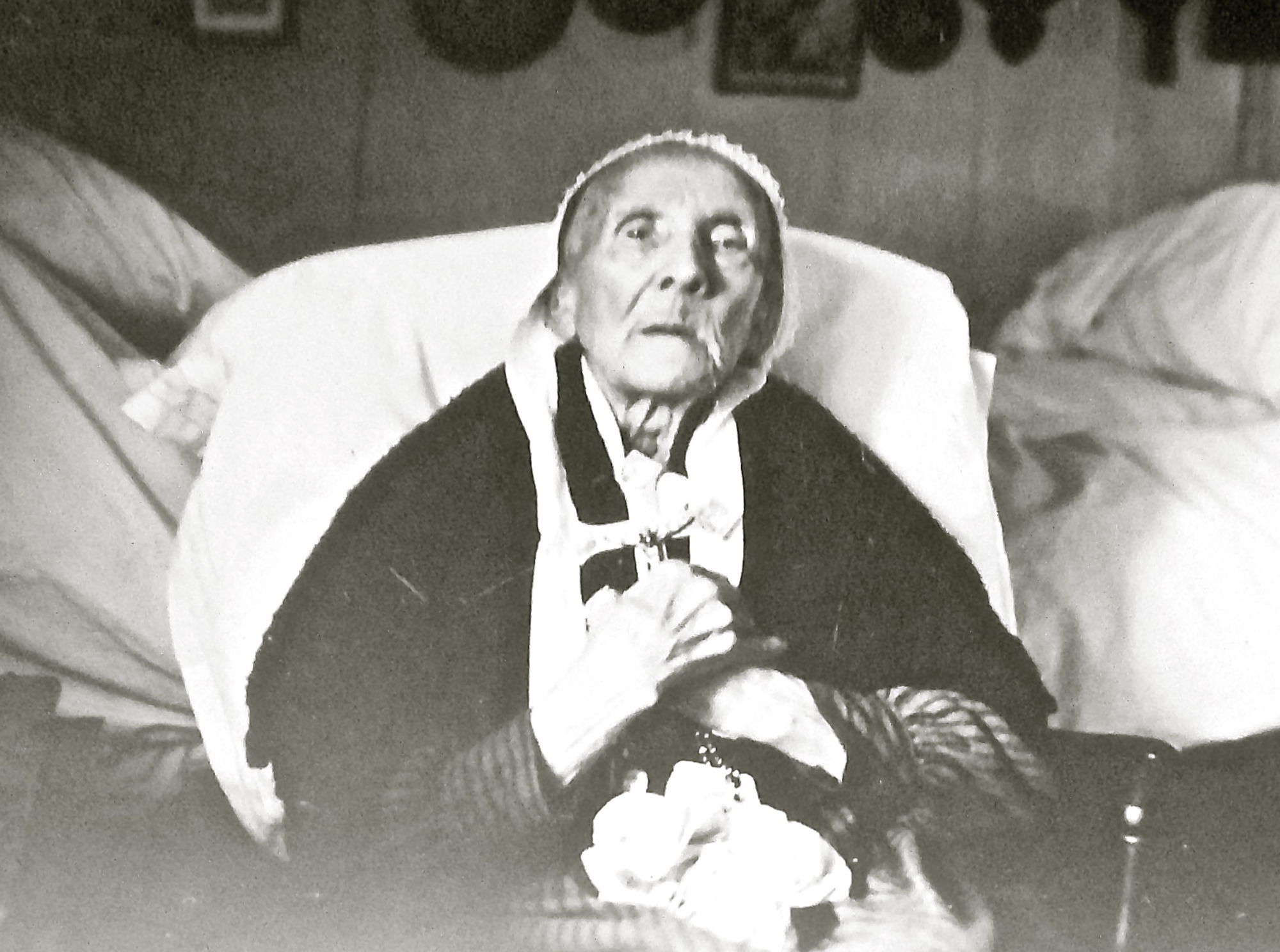
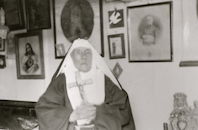
Marie-Julie Jahenny (1850-1941) was a peasant woman from La Fraudais, a hamlet close to the village of Blain and not far from Nantes. From a young age, she expressed her devotion to the Virgin Mary and to the Cross, becoming a Franciscan tertiary years later. Stigmata notwithstanding, Marie-Julie Jahenny was reported to have the gift of prophecy. Her case is exemplary of other nineteenth-century French Catholic female mystics and ‘political prophetesses’, promoters of ultramontanism, millenarism and royalism in the face of the ‘evil’ republican, secularized and post-revolutionary France. Jahenny repeatedly announced the future arrival of a king named Henri V de la Croix – probably Henri d’Artois, Count of Chambord – redeemer of the nation. During her bouts of ecstasy she spoke in patois. Those around her transcribed the prophecies in situ, translating from patois into French.
Marie-Julie Jahenny received the stigmata for the first time on Friday, 21 March 1873, and would continue to bear the wounds of Christ until her death. Before that day, she allegedly saw an apparition of the Virgin, who asked her if she was ready to suffer for the rest of her life for the conversion of sinners – a common mission among stigmatics. That first Friday of 1873, the blood flowed from the sacred wounds in front of her siblings, neighbours and several priests from close villages. From that day onwards, Jahenny’s confronting manifestations continued every Friday, blessing her with all kinds of stigmata. She carried all the imitative wounds (hands, feet, forehead, side and shoulder) and had several figurative stigmata: a wedding ring on her finger (symbolizing the Holy Prepuce and her mystical marriage to Christ), the monograms J.H.S (for Jesus) and M.A. (for Mary) on her chest, and the phrases ‘Viens, ma victime!’ and ‘Triomphe de l’Église’, also on her chest.
The phenomena attracted the attention of thousands of visitors and aroused the suspicion of clergymen in Nantes and Blain. They believed that her spiritual advisor, Father David, was the author of the fraud. Monsignor Félix Fournier, Bishop of Nantes, entrusted two physicians to investigate, with 10,000 people congregating in La Fraudais during the inquiry. The doctors certified the existence of the wounds but denied their supernatural origin; however, the Catholic physician Antoine Imbert-Gourbeyre (1818-1912) disagreed. He and his daughter would become followers and intimate friends of Marie-Julie Jahenny. They were two of the thousands of visitors who would witness her ‘chemin de croix’ in her house on Fridays. One bus driver recalled that before the start of the Second World War he drove many English, Dutch, German and Belgian people to the stigmatic’s house.
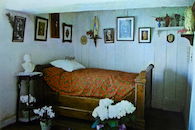
Despite having the diocesan authorities against her, Jahenny achieved ‘living saint’ status among her followers. During her lifetime and after her death, lay associations were created to promote her cause; from the Amis de la Croix, founded in the 1870s, to the current Association Le Sanctuaire de Marie-Julie Jahenny. After Marie-Julie’s passing, her supporters bought her thatched cottage and her possessions in La Fraudais, turning her house into a living museum and shrine that is still a site of unapproved pilgrimage.
References:
Archives Historiques du Diocèse de Nantes, Fonds Marie-Julie Jahenny, 5F2.
Bruno, Jacqueline, 1941. Quelques souvenirs sur Marie-Julie, la stigmatisée de Blain. Saint-Nazaire: Éditions du Courrier de Saint Nazaire.
Guillemain, Hervé, 2006. Diriger les consciences, guérir les âmes. Une histoire comparée des pratiques thérapeutiques et religieuses (1830-1939). Paris: Éditions de La Découverte.
Imbert-Gourbeyre, Antoine, 1894. La stigmatisation. L’extase divine et les miracles de Lourdes. Réponse aux libres-penseurs. Clermont-Ferrand: Librarie Catholique.
Roberdel, Pierre, 1987. Marie-Julie Jahenny la stigmatisée de Blain, 1850-1941. Montsûrs: Résiac.