
Joséphine Rumèbe
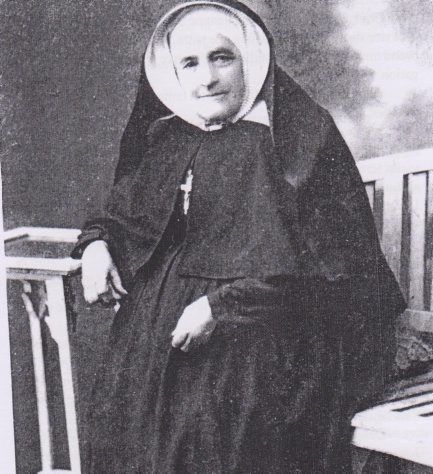
Marie-Jeanne Rumèbe was born in 1850 in Milhas (Haute-Garonne), in the French Pyrénées. She was the youngest child of a family of six children, and her father had a small gypsum mine. Soon after her birth, the family, who were very pious, moved to Aspet. When her mother was young, she had wanted to enter the religious life, while Jeanne’s own religious vocation developed at the age of five, when she allegedly saw Jesus while she was playing. In 1858, her mother took her on a pilgrimage to Lourdes and they are both said to have witnessed the apparition of the Virgin. By then, Jeanne already dreamed about going to Palestine, where she would ultimately end her days.
For a while, Rumèbe thought about joining the missionary congregation of the Sœurs de Saint-Joseph-de-l’Apparition in Marseille, and perhaps leaving for Jerusalem but she could not decide. So, she undertook a secret trip to Lourdes to consult the Virgin with one of the sisters, but this time Jeanne did not receive any revelations. On their way back, one of the pilgrims, a priest, told her that she should join Saint Joseph, but he then disappeared. Jeanne thought that it was Saint Joseph himself who had spoken to her. In November 1868, Jeanne took her vows and became Sœur Joséphine. A few months later, she departed for Jerusalem.
On her arrival in Palestine, she was sent to the Saint-Louis hospital, where she met Amédée de Piellat (1850-1925), an aristocrat from Lyon, who spent his entire fortune on the Catholic missions in the Holy Land. In 1873, an epidemic of cholera occurred in Cyprus and Sœur Joséphine decided to help. While there she became infected and almost died, allegedly recovering after witnessing the apparition of the stigmatized Palestinian Carmelite, Saint Marie de Jésus Crucifié (1846-1878). She returned to Jerusalem in 1878, where she undertook several pilgrimages and continued to work in the hospital, where she was known as Sœur Camomille due to the camomile infusions she gave to the ill.
Around 1900, Sœur Joséphine and Père Lagrange bought land in the village of Abou-Gosh, on the mountain of Kyriat, not far from Jerusalem. Along with Amédée de Piellat, they built a church, convent and a sanatorium on the ruins of an old fifth-century sanctuary. During the First World War, the Ottoman government aimed to expel all clergy from enemy countries and Sœur Joséphine was forced to return to France until March 1919, the date of her return to Jerusalem after its liberation in December 1917 by the English army.
Although she was very discreet with regard to her ‘Holy sufferings’, Soeur Joséphine was said to have carried invisible stigmata from the age of five or six. She said that Jesus knew that she would not be able to carry the visible wounds, and allowed her to suffer without bleeding. These sufferings continued throughout her life, intensifying from time to time – for example, in 1921, the pain in her side was extremely severe. In 1927, the last year of her life, Sœur Joséphine allegedly witnessed the apparition of Saint Thérèse de Lisieux (1873-1897), who released her from the intense pain in her legs. Sœur Joséphine died on 1 September 1927, after 52 years of missionary work in the Holy Land.
References:
Anonymous, 1927. ‘Sœur Joséphine de Jérusalem’. La Croix. 3 September.
Bront, Agnès & La Borie, Guillemette de, 2011. Héroïnes de Dieu: l'épopée des religieuses missionnaires au XIXe siècle. Paris: Presses de la Renaissance.
Stolz, Benedikt, O.S.B., 1972. Cherub auf dem Gotteshügel: Josephine Rumèbe, Gründerin des Heiligtums U.L. Frau von der Bundeslade zu Kirjath-Jearim. Stein am Rhein: Christiana-Verlag.